"How to use existing customers to discover a product gap, create a new USP, and grow conversion without additional budget."
Conversion: 3.5% → 5%90% employed within 6 monthsFirst externship in US online bootcamp market
Slide 01Before
From a market where the brand did the selling, to one where nobody had heard of us.
Russia · the original market
Yandex = Google of the CIS. The brand sold the product.
Referral-led growth. Patience of 12–24 months.
Marketing budget went to product improvement.
Competition was manageable.
No real need to build positioning from scratch.
USA · the new market
Red ocean. Dozens of bootcamps, similar curricula, similar promises.
Brand recognition: zero.
Positioning had to be built from scratch.
Competitor analysis established 3.5% conversion baseline.
The question was what would move it further.
Market and competitor research got us to 3.5%. To go further, we needed to talk to the people competitor analysis couldn't reach: our own graduates.
Slide 02The Insight
Students weren't buying education. But the product was only selling education.
What students said they wanted
"A career in tech"
What the product delivered
Strong technical curriculum. No real-world project history. No employer-facing proof.
What employers were screening for
Evidence of working in a real codebase. Collaboration. Presentation to stakeholders. None of this came from coursework.
Discovery interviews with students at different program stages, graduates in the job market, and employers on the other side of the hiring decision. The pattern was consistent across all three groups.
Slide 03The MVP
Building it meant sitting at the center of five departments at once.
ProductFeature prioritization and roadmap alignment
EngineeringTechnical constraints and platform build
LegalIP agreements with partner companies (US labor law compliance)
CurriculumCourse authors, embedding externship into program structure
MarketingUSP development and conversion testing
Partner acquisition
Cold outreach, LinkedIn, network. 1 in 5 companies said yes. Main objection: IP liability (concurrent with Apple lawsuit against early volunteers). Required companies with bandwidth to give real tasks and stay involved, which filtered out low-commitment partners.
Pilot
2 groups · 17 students · 3 months. Outcomes measured: employer engagement, student project quality, completion rate, feedback from both sides.
Pilot validated the model. Not enough scale to roll out. Led directly to A/B test of the USP.
Slide 04The USP
Same product. Completely different positioning promise.
Before · old landing page
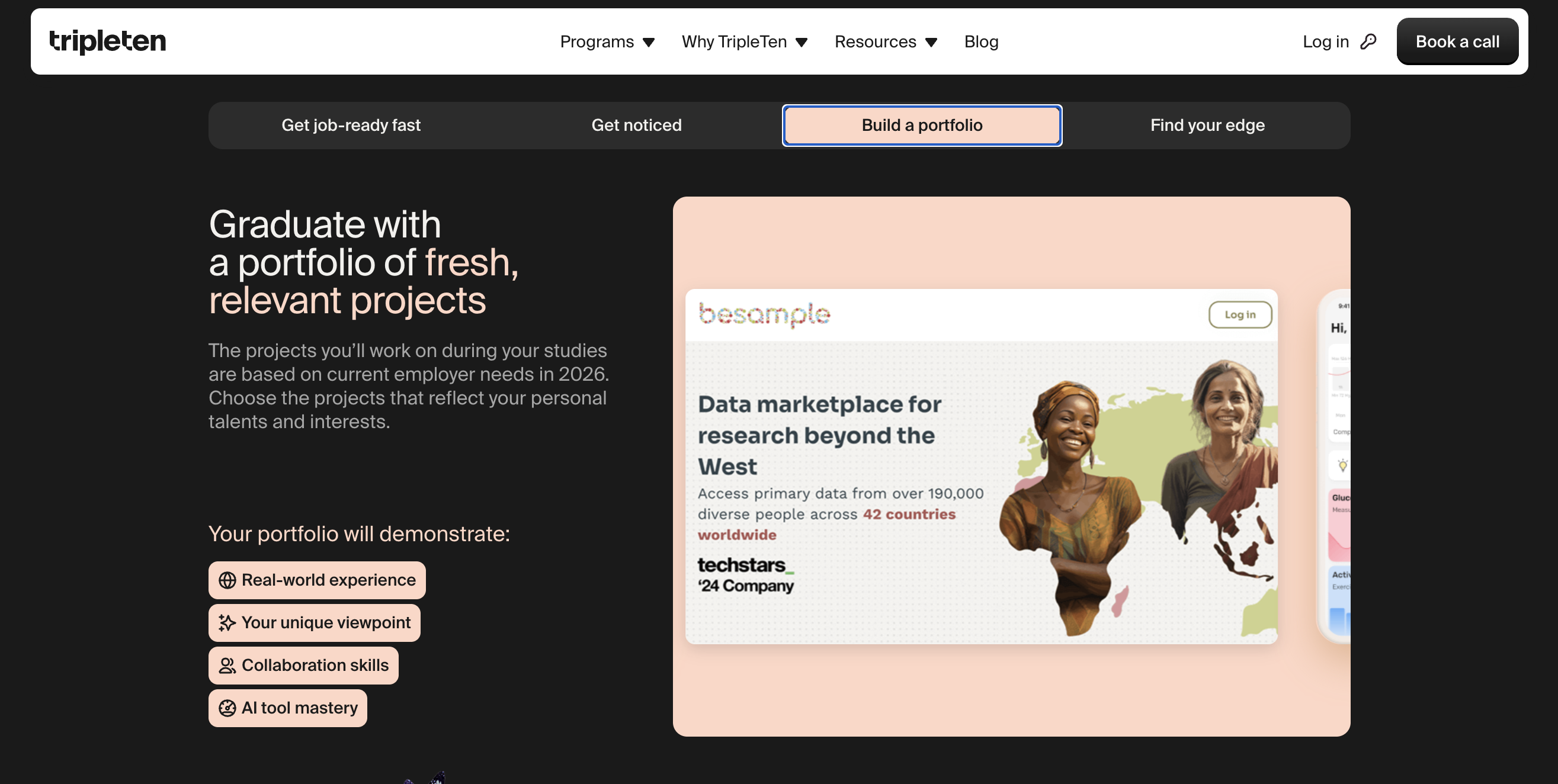
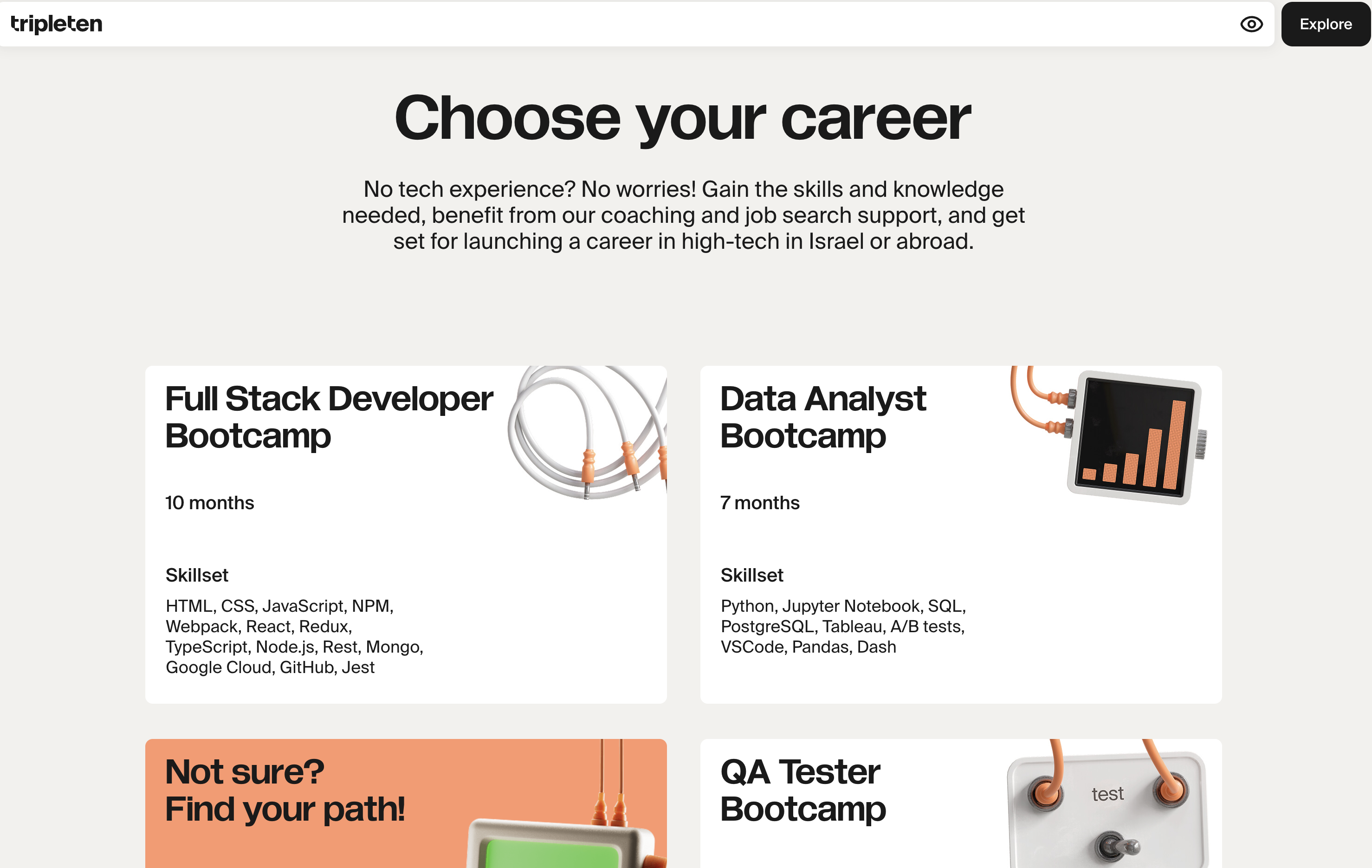
"Choose your career": a menu of tracks. Generic promise. Indistinguishable from every competitor.
After · externship USP
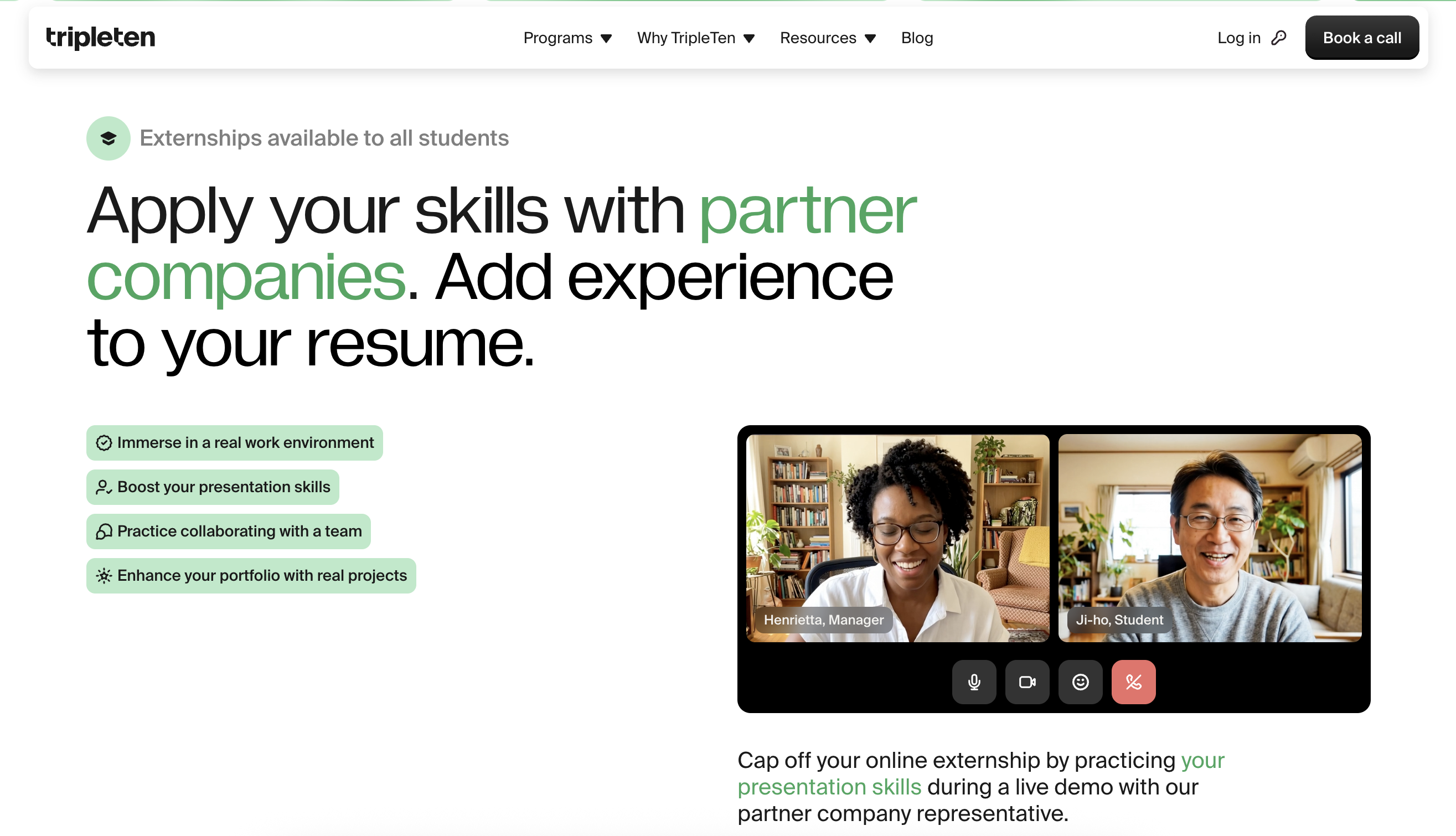
"Apply your skills with partner companies." Real projects as proof on the first screen. A promise competitors couldn't copy without building the same infrastructure.
Slide 05The Numbers
The numbers that followed.
3.5% → 5%
Website conversion · visitor to qualified call lead
90%
Students employed within 6 months, in their specialty
The externship program was the first of its kind in the US online bootcamp market. It generated standalone PR coverage, and gave the sales team a story that converted.
Overview
The setup.
Competitor analysis, market research, and ad testing have their place: they map the category, benchmark positioning, and establish a baseline. But they have a ceiling. They tell you what the market looks like from the outside. They don't tell you where your specific product stops delivering on its specific promise to your specific customer. For that, there's only one source: the people who already bought.
Existing customers are the perfect research subject. They match your ICP by definition. They've experienced your product firsthand. They know exactly where it fell short of what they needed — and often, they have a clear idea of what would have made it better. A single round of honest conversations with them can surface product gaps, new feature ideas, and unmet needs that no amount of competitor analysis would reveal.
The downstream effect goes further than positioning. When the product genuinely closes the gap between what customers bought and what they actually needed, conversion improves, and so does the quality of the leads who convert. The same change that moved the website number also shortened the sales cycle, because leads arrived already understanding what they were getting.
* Practicum by Yandex was rebranded to TripleTen after this program launched. Screenshots reflect the current branding.
Practicum by Yandex came from a market where the brand name did most of the selling. In Russia, Yandex is the Google of the CIS, and that association meant the bootcamp could afford to invest almost entirely in product quality and referral growth, waiting 12 to 24 months for the product to win on its own merits. Competition was manageable. The brand carried the positioning.
The US market was a different problem. Practicum landed in a red ocean: dozens of bootcamps with similar curricula, similar promises, and similar price points, all competing for the same applicants. The brand recognition that worked in Russia meant nothing here. Positioning had to be built from scratch.
Market and competitor analysis established a 3.5% conversion baseline, visitor to qualified call lead. That was the floor the standard research playbook could reach. The question was what would move it further. Brainstorming on conversion improvement led to a round of customer discovery interviews with students at different stages of the program, graduates in the job market, and employers on the other side of the hiring decision.
Those interviews surfaced the gap. Students weren't buying curriculum. They were buying a career change in a country where their credentials didn't transfer and their network didn't exist yet. The product delivered strong technical training, but stopped short of the one thing employers were actually screening for: evidence of working on a real project, with a real team, for a real company. That gap became the hypothesis for the externship program.
Note on methodology: the discovery interviews focused on people who had already bought and completed the program. For the specific question of what was stopping unconverted visitors from enrolling, this is a partial sample: the people who didn't buy weren't in the room. That's a real limitation, and one that the A/B test was partly designed to compensate for by measuring behavioral response on actual traffic rather than self-reported intent.
Process
How it moved.
01Gap mapping between how customers use the product and what they still need to reach their original goal
02Discovery interviews with all participants in the process
03Hypothesis development based on interview patterns
04MVP design and launch
05Hypothesis testing and feedback collection
06USP development grounded in MVP results
07Website positioning and conversion testing
08PR and communications push around the new program as a standalone news moment
Action
What I actually did.
The process started with structured discovery interviews — with students at different stages of the program, with graduates who had already entered the job market, and with the people on the other side of the hiring decision. The pattern that emerged was consistent: the product delivered strong technical training, but left students without the real-world exposure that employers were actually screening for.
That insight became the hypothesis: a structured externship component, embedded into the program before graduation, would close the gap and give students something employers could evaluate. I designed an MVP around that hypothesis and ran partner acquisition from scratch: cold outreach, LinkedIn, and my own network plus colleagues'. One in five companies said yes. The main objection wasn't relevance, it was liability. This was concurrent with Apple's lawsuit against early volunteers over IP ownership, which made legal teams at small and mid-size companies nervous about any arrangement where student work touched their codebase. I worked with our legal team to structure agreements that protected both sides clearly. I also filtered for companies with actual bandwidth to engage: the program only worked if the partner representative gave real tasks and stayed involved. Low-commitment partners produced low-quality projects, which produced low-quality portfolio entries, which defeated the purpose.
The pilot results validated the model. Student outcomes improved measurably: completion rates and employment within 6 months both moved. On the employer side, I tracked behavioral signals, not just satisfaction: did they engage with the student work, give substantive feedback, and agree to take a second cohort. Those who did became the foundation for the scaled program. The program created a credible, specific promise that the existing product couldn't make. That became the basis for a new USP — a positioning move away from generic 'learn and get hired' territory toward a verifiable, structured pathway with real employer partnerships as proof.
The new program was then used as a PR moment in its own right: the first externship of its kind in the US EdTech market was a story worth telling, and it drove additional awareness beyond what the website conversion work alone would have produced.
The pilot ran with two groups, 8 and 9 students, over three months. I coordinated across five teams: Product, Engineering, Legal, Curriculum (the course authors who had to embed the externship into program structure), and Marketing. Each had a different set of constraints and a different definition of what "done" looked like. After the pilot validated the model, I built the scaling infrastructure: hired and mentored two team members, created the knowledge transfer framework, trained six colleagues, and expanded the program across three bootcamp verticals. The USP lift was then confirmed via A/B test, and that result lives in the next case study.
Before
After
Fig. 01Before: a generic bootcamp menu — pick a track, get a job. Indistinguishable from every competitor. After: portfolio of real projects built for real employers, the externship reframed as the reason to enroll. Same product underneath; completely different positioning promise — and a story the market could actually repeat.Fig. 02The externship program page itself. The headline — Apply your skills with partner companies — is the USP in one sentence. Every downstream marketing asset, PR angle, and enrollment conversation traces back to this frame.
Grew website conversion from 3.5% to 5% and lifted 6-month employment rate to 90% by identifying a gap between what the product delivered and what employers actually screened for, then building the externship program, validating it in a 17-student pilot, and scaling it across three bootcamp verticals.
What I'd do differently
Make employers the second paying segment. Companies that genuinely value "this junior worked in production" are a market, not favor-givers. A fee for access to the student pipeline would have proven the value with money rather than polite feedback, and made partner supply grow with demand instead of depending on goodwill. The most defensible asset in the program stayed free.
Measure behavioral signals on the employer side, not satisfaction. "Employer feedback was positive" isn't proof: people praise what's free. From the first pilot, I'd track three things: did they hire anyone, did they take a second cohort, would they pay. The USP would then be built on "X companies came back for a second cohort", a claim that can't be faked.
Test the message before building the product. The sequence was: build the externship, then test whether the USP moved conversion. A two-week fake door, a landing page with the new promise and a waitlist, would have answered the conversion question before the first partner conversation. The counterargument is honest: the externship improved the product itself, so it was worth building regardless. But those are two separate decisions that got treated as one.
Design the pilot with a matched control group. If the externship was optional or required extra effort, the most motivated students self-selected in, and those students would have found jobs anyway. Without a matched control, the 90% outcome number can't cleanly separate program effect from selection effect. At pilot scale, setting that up costs almost nothing. Defending the number later, to a regulator or an investor, costs significantly more.
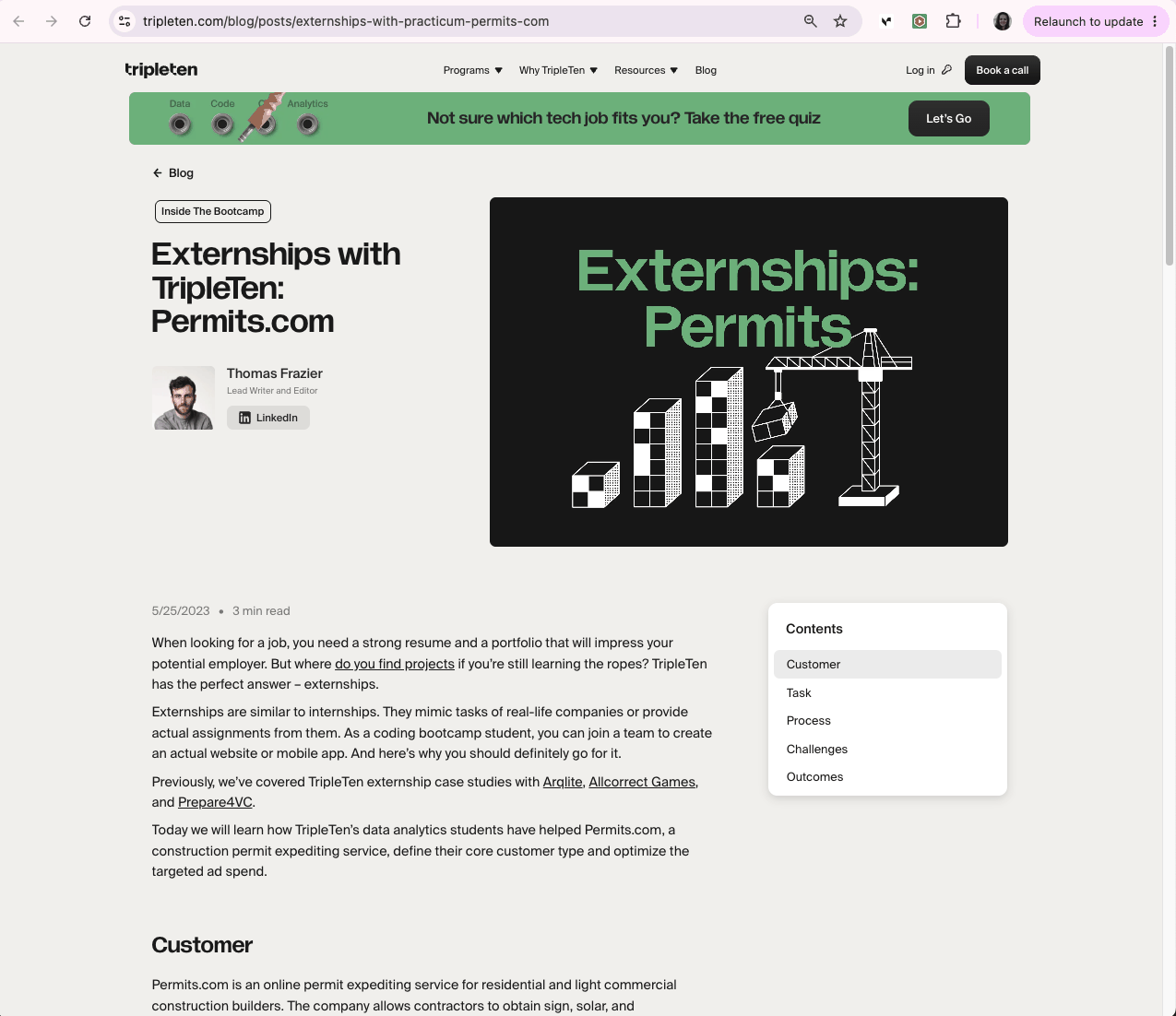 Externships with TripleTen: Permits.comtripleten.com/blog
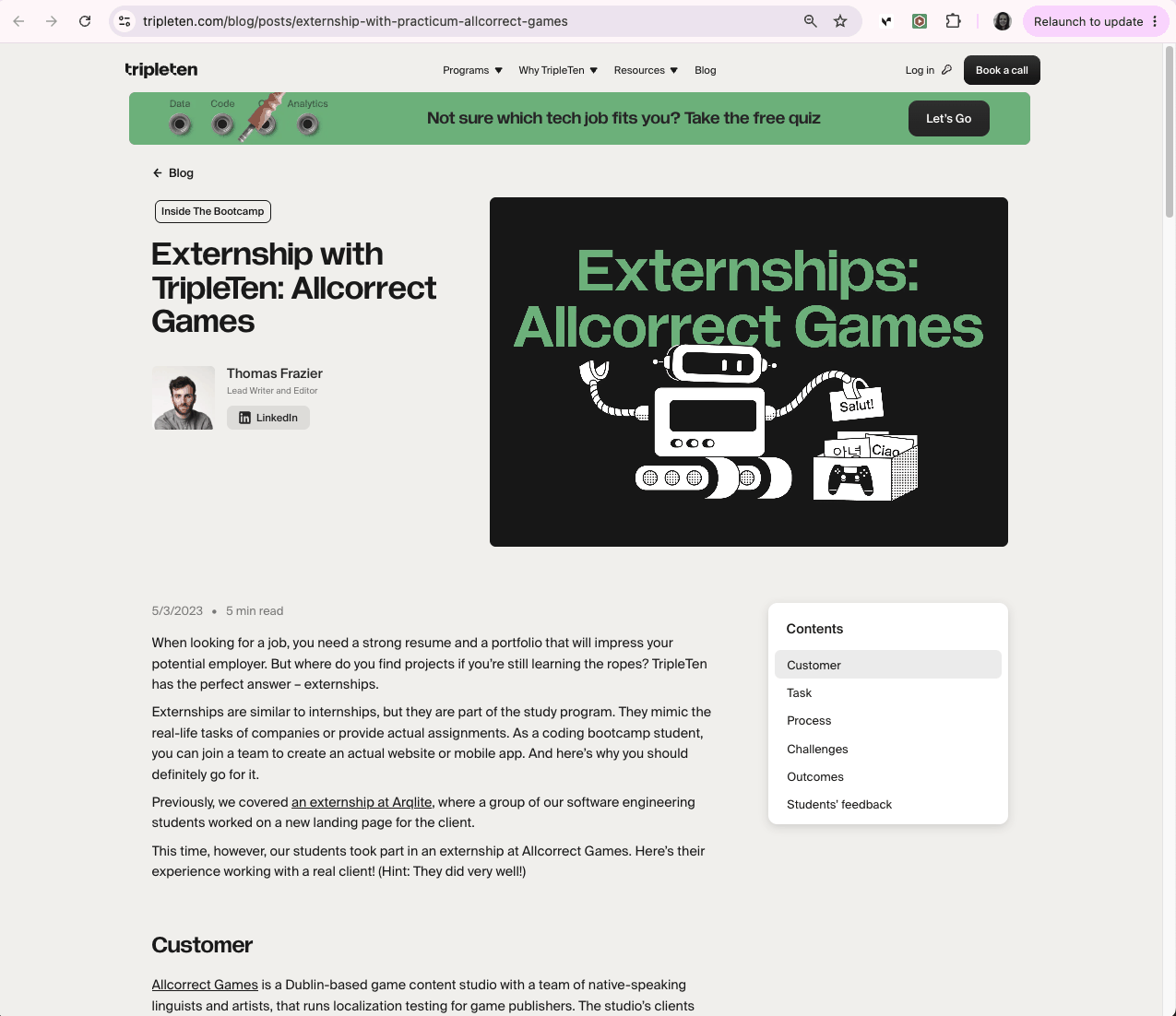 Externship with TripleTen: Allcorrect Gamestripleten.com/blog
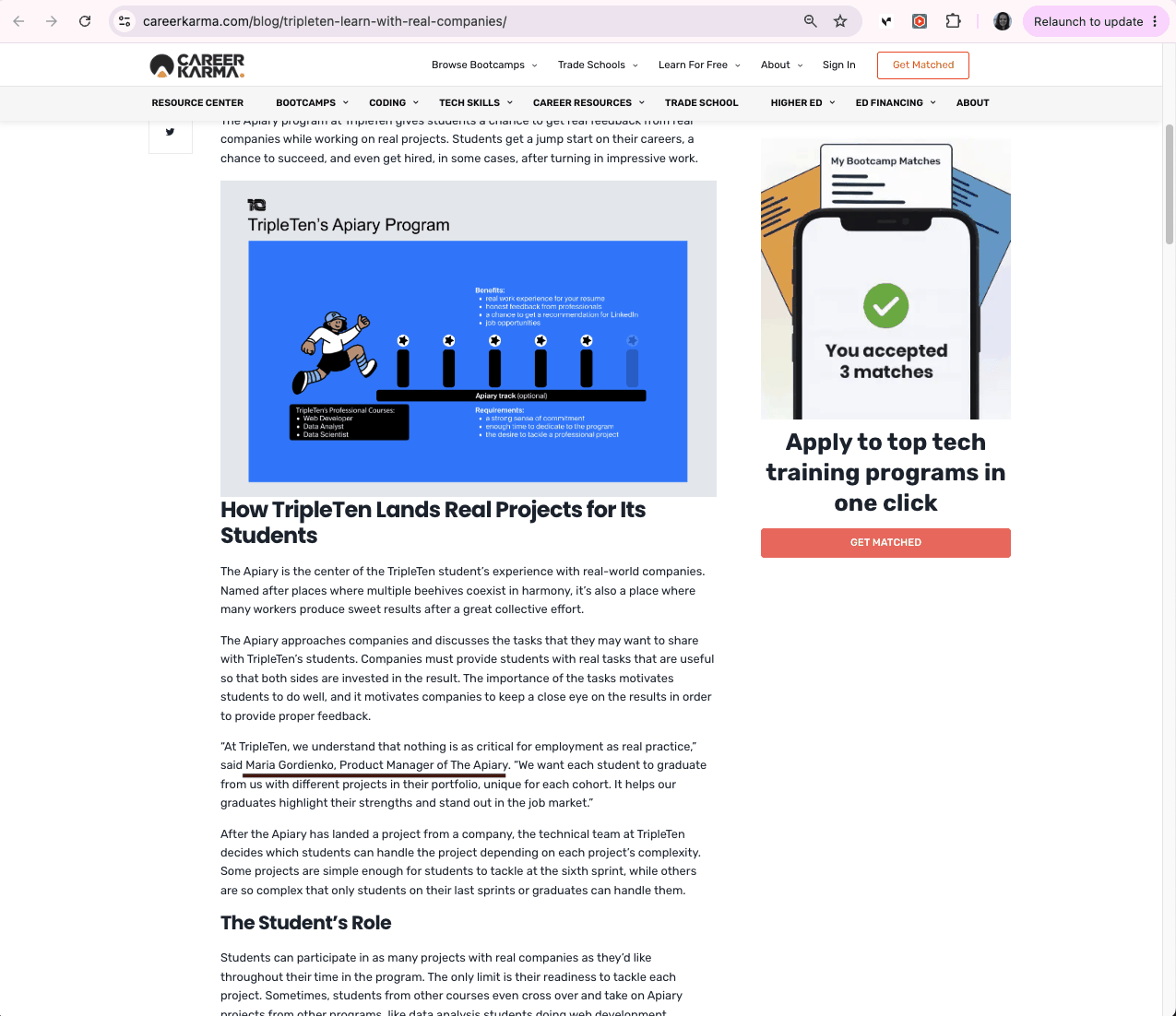 "Learn with real companies"Career Karma · careerkarma.com