"How to validate market demand before the full product is built, by shipping an MVP that shows exactly what buyers need to see."
$10M in pre-orders16 days from decision to demoATOMEXPO 2016
Slide 01The Context
B2B2B · The classic end-user / buyer split, at scale
The client was selling nuclear reactors. The LMS was the upsell.
The client: RUSATOMSERVICE
A division of Rosatom, Russia's state nuclear energy corporation.
Rosatom 2016 revenue: $12.91B (IFRS). 34 reactor units under construction in 12 countries.
Deal structure: Universarium → RUSATOMSERVICE → nuclear power plant operators.
The people paying for the LMS and the people using it were two completely different organizations.
The LMS was designed to replace the live trainer. We were building it.
The open question
Would the end users, nuclear power plant operators, actually accept a digital LMS instead of a human trainer?
Nobody had asked them yet.
RUSATOMSERVICE needed to know before signing further contracts with their buyers.
The LMS was mid-development. The answer didn't exist yet.
RUSATOMSERVICE was our largest client. The contract was in its middle stage. Everything depended on whether their buyers would accept the product we were building.
Slide 02The Decision
ATOMEXPO 2016 was 16 days away. The LMS wasn't ready. We went anyway.
The opportunity
ATOMEXPO, Russia's largest nuclear industry forum. June 2016, Moscow.
Future LMS users: operators from nuclear plants across Russia and internationally, all in one room.
First and only chance to get live user feedback before the full product shipped.
The risk
If the audience rejected the LMS concept, it would put the entire RUSATOMSERVICE contract in question.
If we didn't go: the LMS would ship without real user validation.
Decision made jointly with the CEO: the risk of no feedback outweighed the risk of bad feedback.
The upside of negative feedback
We were mid-contract. If the demo surfaced real objections, we had time to fix them before delivery.
Bad feedback at ATOMEXPO was recoverable. Bad feedback after full delivery was not.
Going was the lower-risk option.
Slide 03The Demo Design
The demo had one job: show that a screen can teach what a trainer teaches.
The main fear from both RUSATOMSERVICE and their buyers: operators wouldn't absorb information from a screen. Wouldn't focus. Wouldn't retain. My decision: design the demo around proving exactly that, and make the learning delta visible in under 10 minutes.
Step 01 · Entrance test
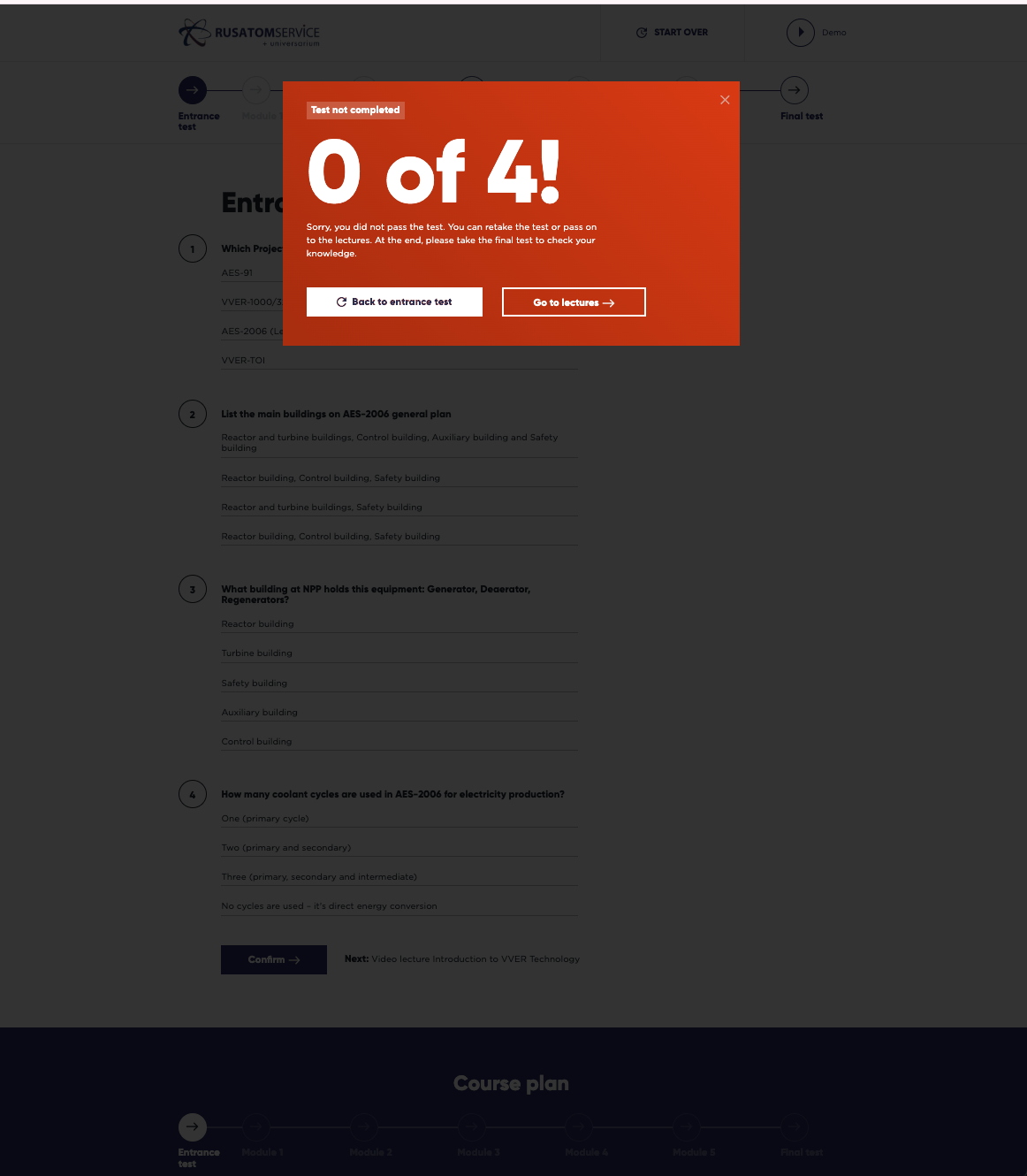
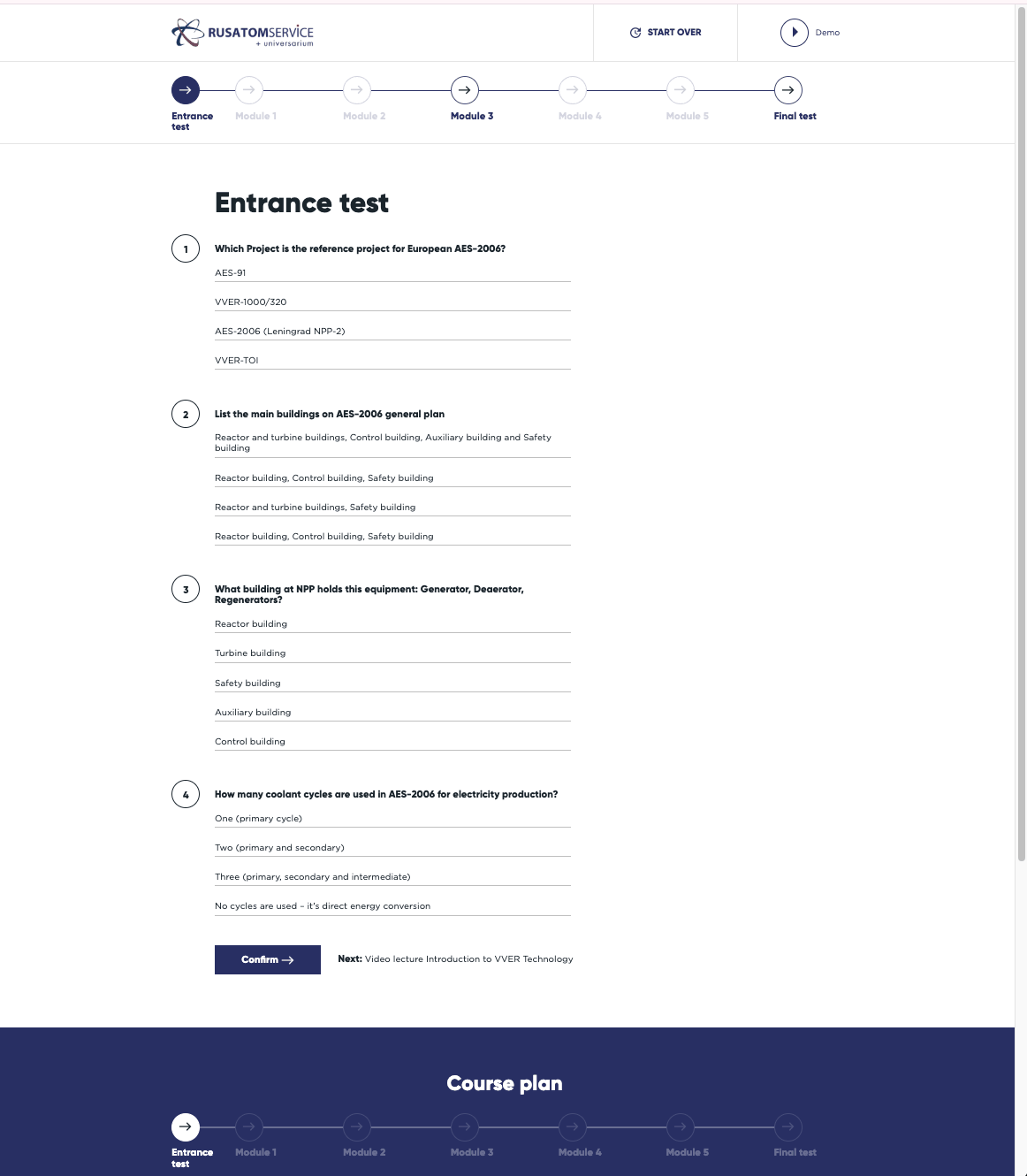
4 questions on nuclear reactor fundamentals. Result shown immediately: 0 of 4.
Step 02 · Video lecture
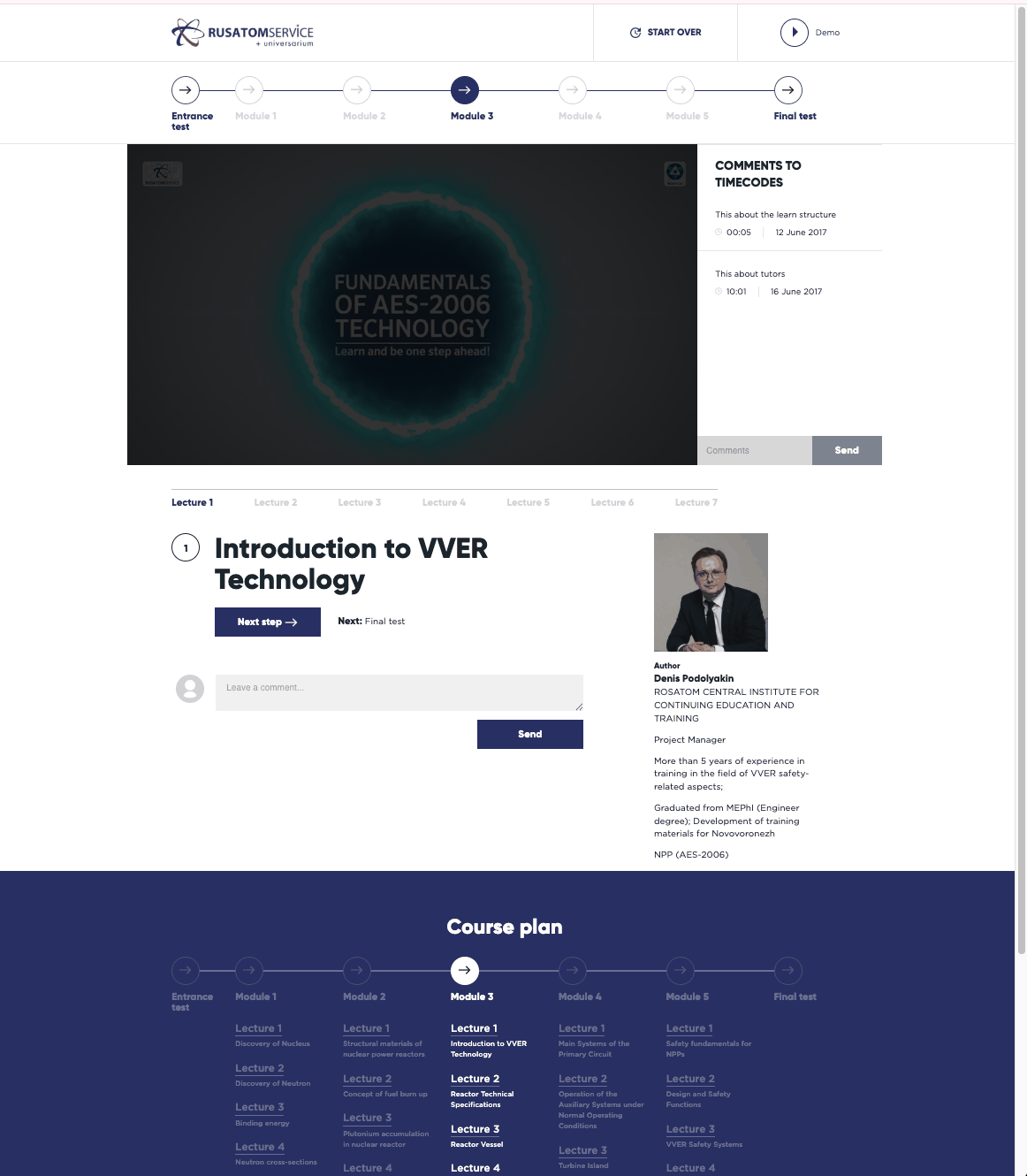
Introduction to VVER Technology · Module 3. Comments tied to timecodes · 2-3 min segments · random-interval knowledge checks.
Step 03 · Final test
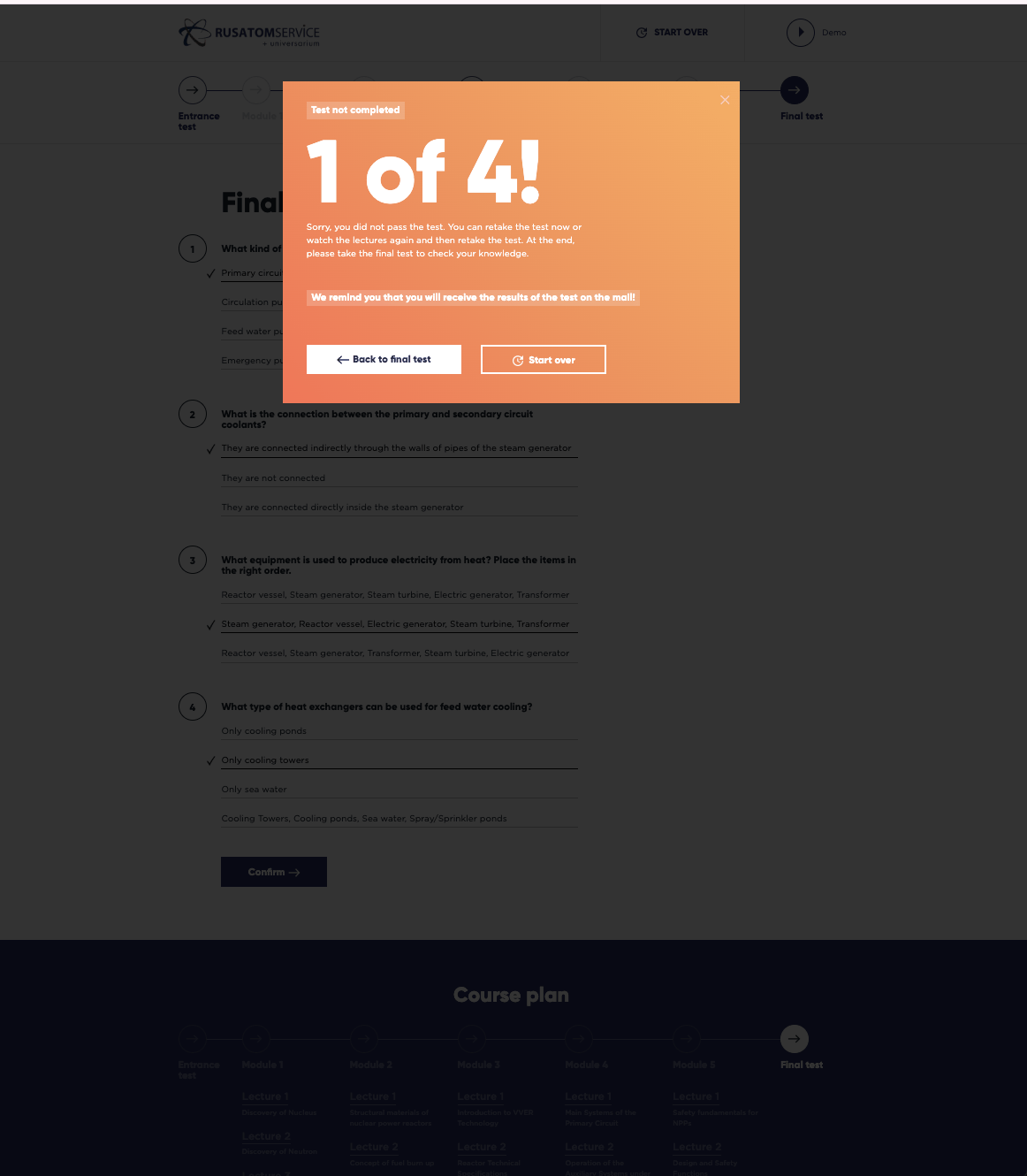
The same 4 questions. Result emailed automatically.
The delta between entrance and final test score was the product's proof. Not a promise about what the platform could do, but a demonstration of what it just did. Built in 16 days, shown on a conference floor at a major international industry event.
Slide 04The Platform
What the demo actually looked like.
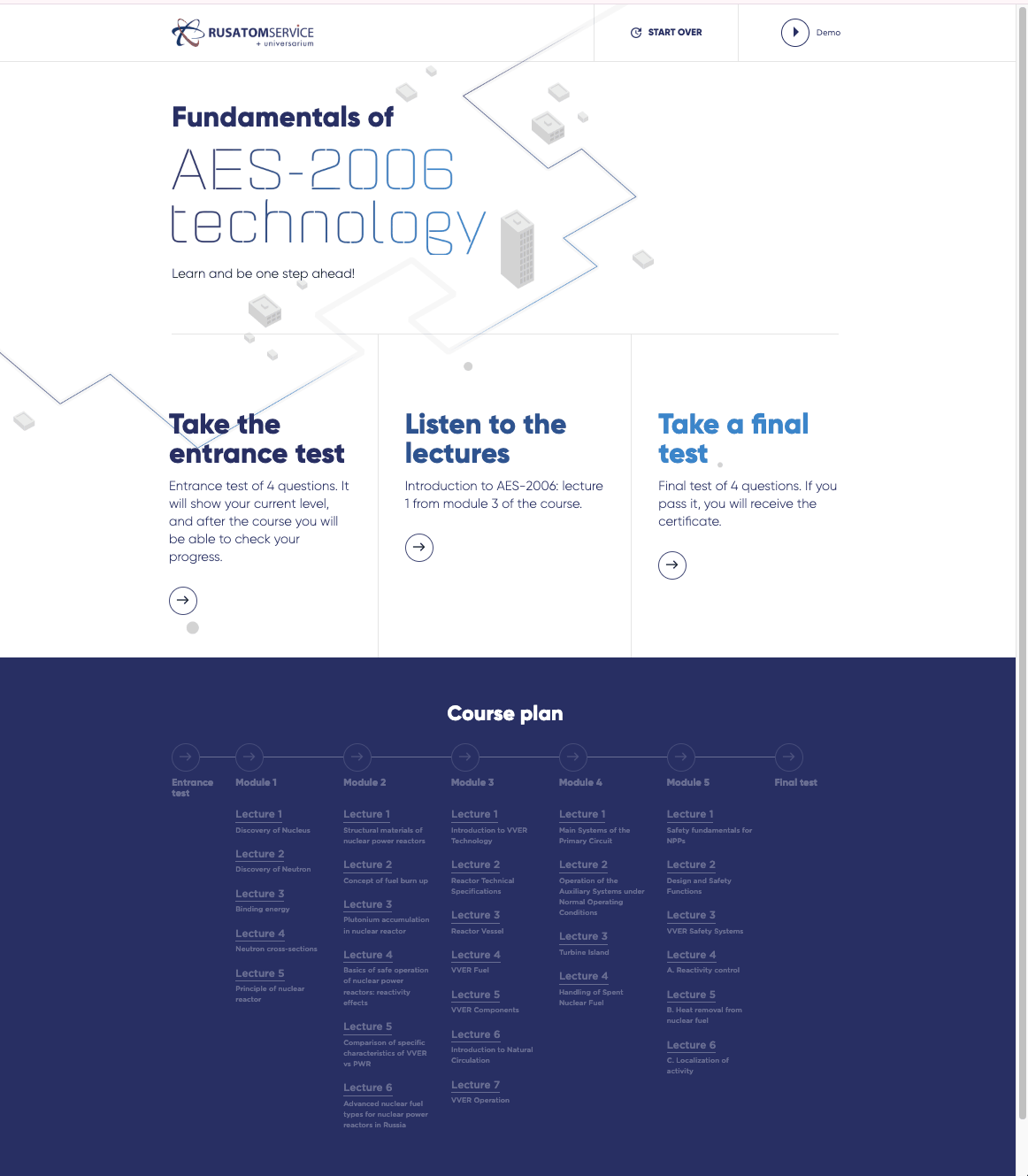
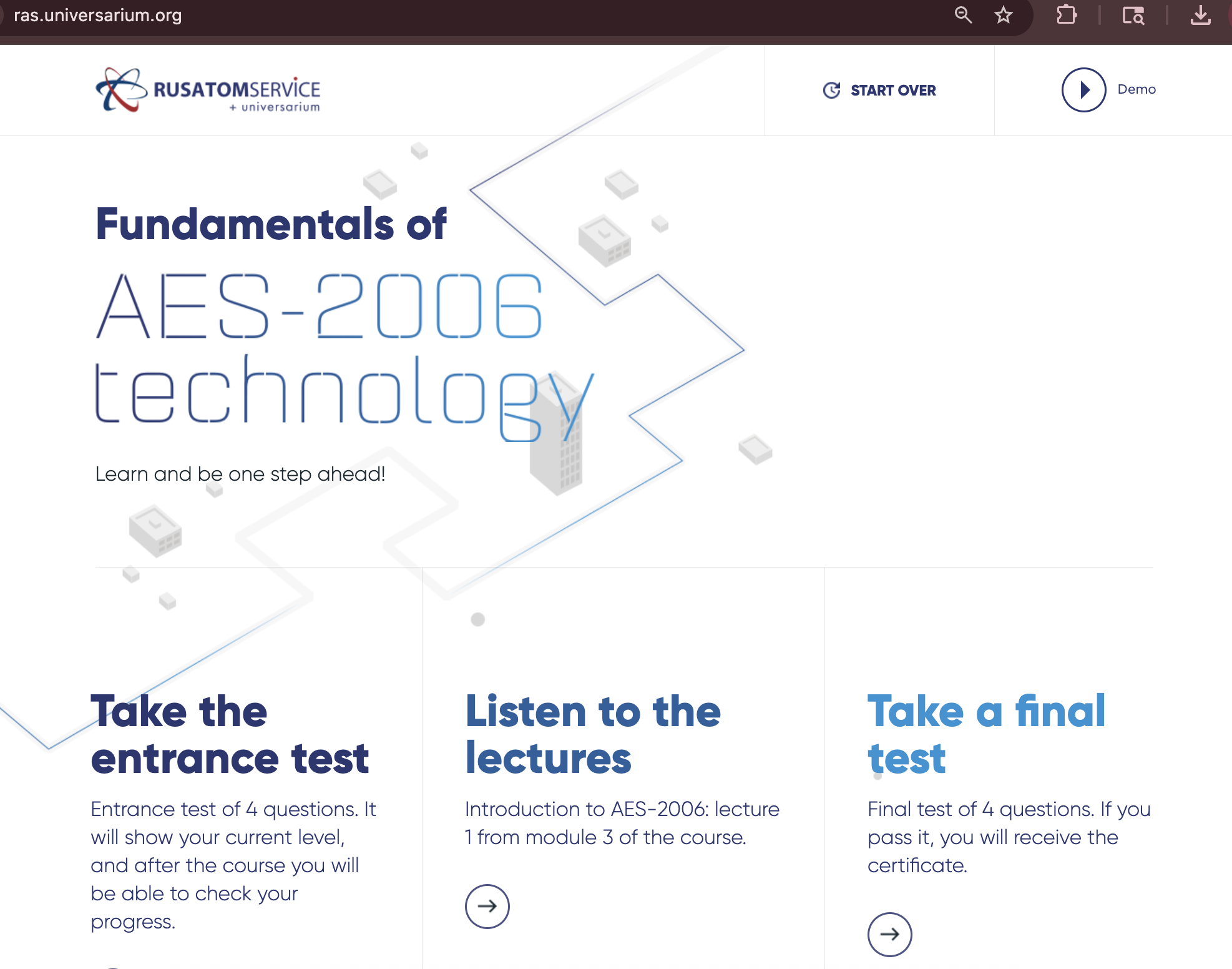
Demo landing page
Three-step flow clearly visible. Full course plan below, showing the scope of the full product.
Entrance test
4 questions. Immediate result. The baseline before the lecture.
Video lecture
Timecode-anchored comments. A 2016 feature that kept attention on a conference floor.
Final test result
Emailed automatically. Proof of learning delta delivered to the user's inbox.
Slide 05The Event + Result
ATOMEXPO 2016. The demo ran. The objection dissolved.
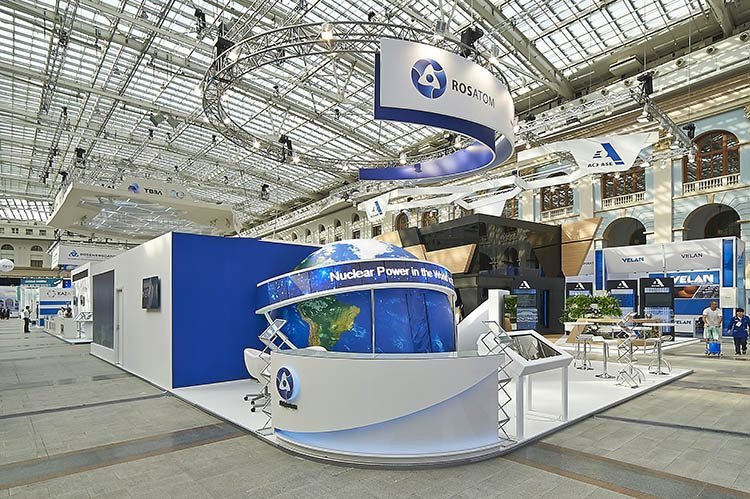
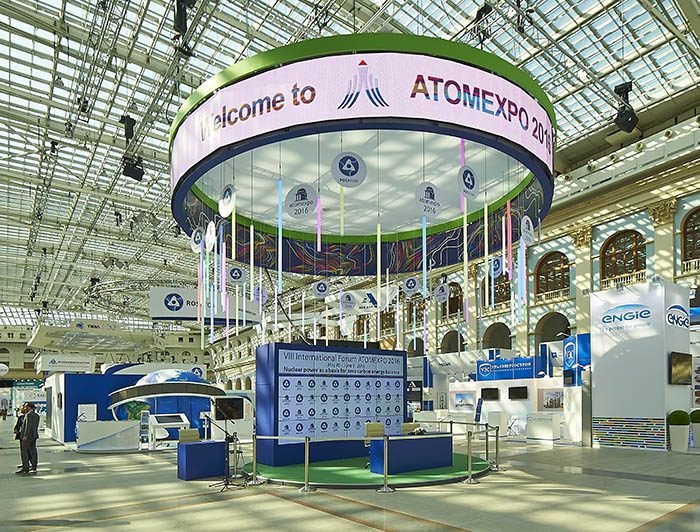
RUSATOMSERVICE stand at ATOMEXPO 2016
ATOMEXPO 2016, Moscow · VIII International Nuclear Forum
$10M
in pre-orders closed at the event
16 days
from decision to demo delivery
1
core objection designed into the demo and resolved on the floor
2016
timecode comments, a feature that kept operators engaged in a noisy hall
Overview
The setup.
Industry events are one of the highest-leverage moments in a product's go-to-market timeline. The right conference puts you in the same room as your ideal buyers, your competitors, and the people who shape opinion in your market — all at once. Missing that window doesn't just cost you visibility. It hands the stage to someone else.
But showing up with an incomplete product is a risk most teams aren't willing to take. The instinct is to wait until everything is ready. The problem is that 'ready' is a moving target, and the market doesn't pause while you polish. Companies that figure out how to demonstrate value before the full product exists — through a focused, well-designed demo that speaks directly to what buyers care about — consistently outmaneuver competitors who are still waiting for launch day.
Local Coursera — one of the three leading EdTech platforms in Russia, winner of the "Made in Russia" award.
This was a B2B2B engagement, and a textbook example of the end-user / buyer split. Universarium's client was RUSATOMSERVICE. RUSATOMSERVICE's clients were nuclear power plant operators and their parent organizations. The people who would pay for the LMS and the people who would use it were two completely separate groups, with different concerns, different success criteria, and no shared seat at the table when the contract was signed.
That structure created a specific problem: RUSATOMSERVICE was buying an LMS on behalf of buyers who hadn't been consulted yet. The commercial decision was made at one level of the chain. The acceptance decision would happen at another.
RUSATOMSERVICE, a division of Rosatom, was Universarium's largest client. The engagement: build an LMS that would replace live on-site trainers in the training of nuclear power plant operators. When a buyer purchased a nuclear power unit, they also purchased operator training. The LMS was designed to become that training, digitally, at scale, without a human trainer in the room.
The LMS was mid-development in June 2016 when we learned that ATOMEXPO, Russia's largest nuclear industry forum, was taking place in 16 days. The event would bring together the exact people whose acceptance of the LMS would determine whether the product succeeded: nuclear power plant operators and their managers, the future end users of what we were building.
The core concern, shared by RUSATOMSERVICE and their buyers alike, was whether operators would actually absorb technical information from a screen. The live trainer model had been standard for decades. The assumption was that digital training meant lower retention, less engagement, and operators who would click through without learning anything. Nobody had tested that assumption yet against real users.
There was a real risk in going. If the audience at ATOMEXPO rejected the LMS concept, it would put the entire RUSATOMSERVICE contract in question, a client whose 2016 revenue was $12.91B by IFRS. That conversation with our CEO was direct: we were mid-contract, with time remaining to course-correct if the feedback was negative. The risk of showing an unfinished product was lower than the risk of delivering a finished one that users had never validated. We decided to build a demo and go.
The companies that win at industry events are rarely the ones with the most complete product. They are the ones who figured out which part of the product answers the buyer's most urgent question, and showed exactly that.
Process
How it moved.
01Customer pain point analysis to identify top priority features
02Demo scope definition based on buyer decision criteria
03Team formation and role assignment
04Sprint planning with risk mapping
05Build and QA across 16-day timeline
06Demo narrative and before/after visual design
07Conference delivery and prospect follow-up
Action
What I actually did.
In a B2B2B structure, the demo had two audiences at once: RUSATOMSERVICE, who needed to believe the product would satisfy their buyers, and the operators themselves, who needed to experience it directly. The demo had to work for both: commercial confidence for one, felt learning for the other.
The first decision was scope, and I made a specific call: design the demo around the one objection we knew the audience would bring. The fear, from both RUSATOMSERVICE and their buyers, was that operators wouldn't absorb information from a screen. They would zone out, click through, retain nothing. The demo had to answer that directly, and it had to do it in under 10 minutes on a noisy conference floor.
The structure I chose: entrance test, then lecture, then final test. Four questions before the lecture, the same four questions after. The delta between the two scores was the proof: not a promise about what the platform could do, but a demonstration of what it just did. That learning delta was the centrepiece of every conversation at the conference.
The lecture itself was built to keep attention in a chaotic environment. Segments of 2-3 minutes. Random-interval knowledge checks inside the video. And a feature that stood out even by today's standards: the ability to leave comments tied to specific timecodes, so a question about something at 10:01 stayed anchored to 10:01, not buried in a general thread. This was 2016. It worked on the conference floor because it turned passive watching into active engagement.
Final test results were emailed automatically to the participant. That detail closed the loop for managers standing nearby: they could see that their operators would receive a documented record of what they had learned.
A team was assembled: a programmer, a designer, a front-end developer, and a QA tester. Sprint planning was done with risk awareness built in from the start. Every task was sequenced around the demo narrative, so the build always served the story we needed to tell on the conference floor.
The demo delivered. Conversations moved quickly from product questions to commercial ones. The pre-order volume reflected both the quality of the demo and the strength of the underlying market demand.
Fig. 01The LMS demo that closed the deal — Fundamentals of AES-2006 technology, co-branded RUSATOMSERVICE × Universarium. Three modules visible: entrance test → lecture → final test, the sequence that made before/after learning outcomes legible to a commercial buyer in under a minute.
Note: this is the public sandbox environment — it carries a "2006" label instead of the real "2016" course code so the live commercial version stays separate. ras.universarium.org ↗
Result
Measurable outcomes.
Secured $10M in pre-orders at ATOMEXPO 2016: conversations moved from product questions to commercial ones on the conference floor
Demo built and delivered in 16 days with a team of 4: programmer, designer, front-end developer, QA tester
Core user objection (retention without a live trainer) addressed directly in the demo structure and resolved in real time
Product entered market with live user validation before full delivery: feedback confirmed the build direction
Pre-Order VolumeTime-to-DemoFeature Adoption SignalPipeline Conversion at EventEvent ROI
Resume
In a B2B2B deal where the buyer and the end user were different organizations, secured $10M in pre-orders at ATOMEXPO 2016 by designing a demo that answered the end user's core objection in real time: built the entrance test, lecture, and final test flow to show learning delta in under 10 minutes, assembled and led a 4-person team, and shipped in 16 days.
What I'd do differently
The demo proved the wrong thing. The stated objection was "operators won't retain information from a screen." The demo showed a delta between entrance and final test scores on the same four questions, ten minutes apart. That's not retention, it's recognition of content just heard, amplified by the priming effect of repeated questions. Any learning designer or training director reads that immediately. Today I'd run the final test on different questions that check transfer, not reproduction, and send the same test by email seven days later. A delayed result would be real evidence of retention, and it would create a second touchpoint with every participant who went through the demo.
The real objection probably wasn't about retention at all. When people are asked why they resist replacing a human trainer, they say "because of learning outcomes", because that's the acceptable answer. Underneath it is usually liability: who is responsible if an operator certified by a video course makes an error at a nuclear plant. That objection can't be resolved by a demo. It gets resolved by a certification protocol, an audit trail, and a signature. Ten interviews with operators and training managers before the sprint would have shown which of the two objections was the real one. Sixteen days went toward answering the stated one.
Build the commercial conversation into the demo flow. The demo proved the product worked. Conversations at the event moved to commercial questions, but that transition happened organically, not by design. If I did this again, I'd build a structured handoff into the demo itself: a clear next step for interested buyers before they walked away from the stand.
Instrument the demo to capture behavioral data. We saw that people engaged. We didn't measure how long they stayed, where they dropped off, or which module generated the most questions. Instrumented analytics on the demo would have given us a second layer of validation beyond what people said: what they actually did.